


 Cart
Cart
 sales@molnova.com



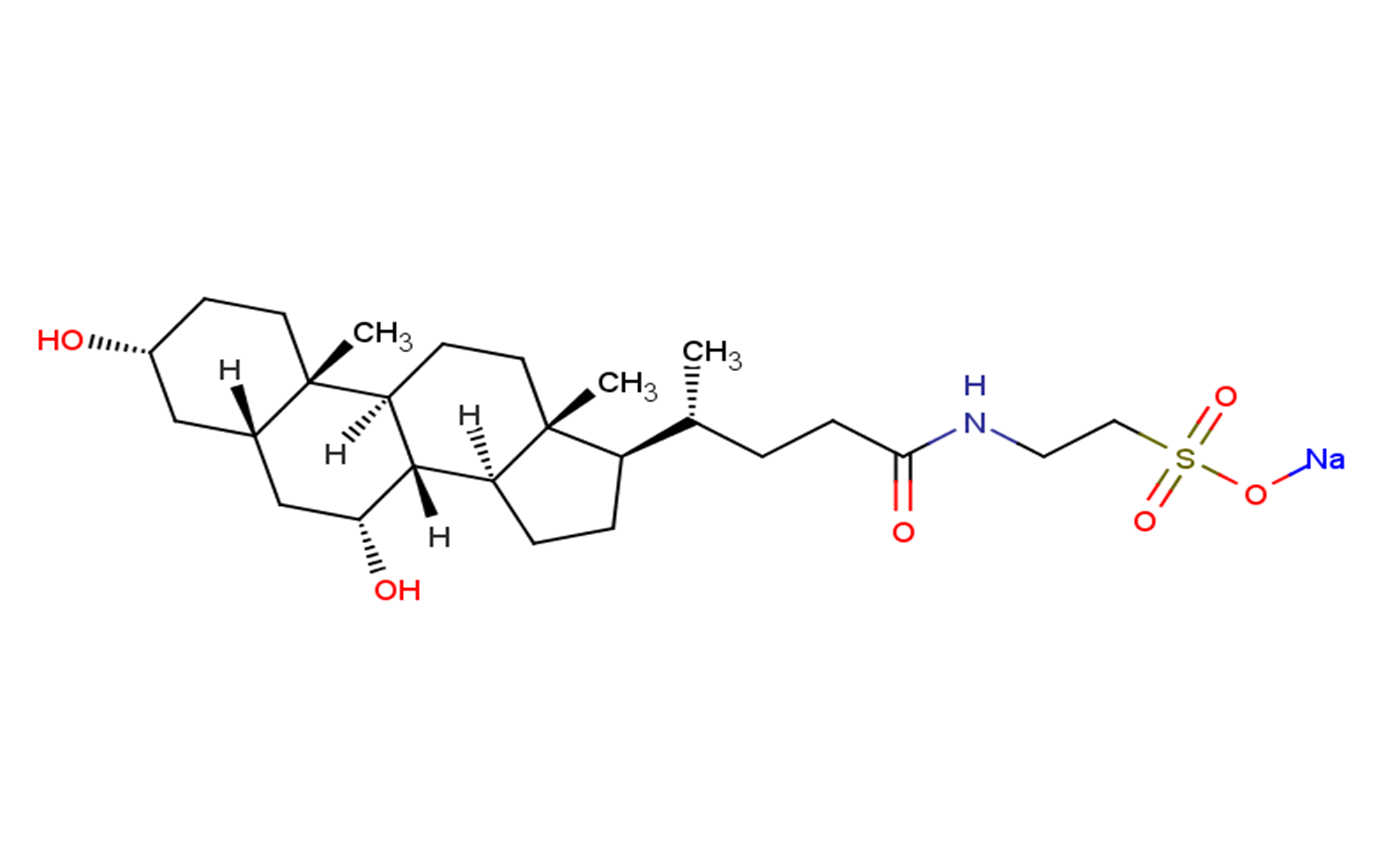
Sodium taurochenodeoxycholate
CAS No. 6009-98-9
Sodium taurochenodeoxycholate( —— )
Catalog No. M22823 CAS No. 6009-98-9
Sodium taurochenodeoxycholate is one of the main bioactive substances of animals' bile acid.?Sodium taurochenodeoxycholate induces apoptosis and shows obvious anti-inflammatory and immune regulation properties. It can increase glucose-induced insulin secretion and stimulate the electrical activity of α2-cells and enhance cytosolic Ca(2+) concentration ([Ca(2+)](c)).
Purity : >98% (HPLC)
 COA
Datasheet
HNMR
HPLC
MSDS
Handing Instructions
COA
Datasheet
HNMR
HPLC
MSDS
Handing Instructions
| Size | Price / USD | Stock | Quantity |
| 100MG | 41 | In Stock |


|
| 200MG | Get Quote | In Stock |
|
| 500MG | Get Quote | In Stock |
|
| 1G | Get Quote | In Stock |
|
Biological Information
-
Product NameSodium taurochenodeoxycholate
-
NoteResearch use only, not for human use.
-
Brief DescriptionSodium taurochenodeoxycholate is one of the main bioactive substances of animals' bile acid.?Sodium taurochenodeoxycholate induces apoptosis and shows obvious anti-inflammatory and immune regulation properties. It can increase glucose-induced insulin secretion and stimulate the electrical activity of α2-cells and enhance cytosolic Ca(2+) concentration ([Ca(2+)](c)).
-
DescriptionSodium taurochenodeoxycholate is one of the main bioactive substances of animals' bile acid.?Sodium taurochenodeoxycholate induces apoptosis and shows obvious anti-inflammatory and immune regulation properties. It can increase glucose-induced insulin secretion and stimulate the electrical activity of α2-cells and enhance cytosolic Ca(2+) concentration ([Ca(2+)](c)).Experiments were performed with islets from wild-type, farnesoid X receptor (FXR) knockout (KO), and β-cell ATP-dependent K(+) (K(ATP)) channel gene SUR1 (ABCC8) KO mice, respectively. Sodium taurochenodeoxycholate (TCDC) increased glucose-induced insulin secretion. This effect was mimicked by the FXR agonist GW4064 and suppressed by the FXR antagonist guggulsterone. TCDC and GW4064 stimulated the electrical activity of β-cells and enhanced cytosolic Ca(2+) concentration ([Ca(2+)](c)). These effects were blunted by guggulsterone. Sodium ursodeoxycholate, which has a much lower affinity to FXR than TCDC, had no effect on [Ca(2+)](c) and insulin secretion. FXR activation by TCDC is suggested to inhibit K(ATP) current. The decline in K(ATP) channel activity by TCDC was only observed in β-cells with intact metabolism and was reversed by guggulsterone. TCDC did not alter insulin secretion in islets of SUR1-KO or FXR-KO mice. TCDC did not change islet cell apoptosis.
-
In VitroTaurochenodeoxycholic acid (12-Deoxycholyltaurine) sodium dramatically improves the apoptosis rate of NR8383 cells in a concentration-dependent manner. In the meantime, Taurochenodeoxycholic acid sodium significantly augments PKC mRNA levels, activities and increases JNK, caspase-3 and caspase-8 mRNA expression levels, activities.
-
In VivoTaurochenodeoxycholic acid (12-Deoxycholyltaurine; TCDCA; 0.05, 0.1g/kg) sodium decreases the pulmonary coefficient in the model mice and reduces the pathological damages on their lungs; it can decrease the expression levels of TNF-α and TIMP-2 in pulmonary tissues in the pulmonary fibrosis mice and has no significant effects on MMP2. Taurochenodeoxycholic acid sodium significantly normalizes the clinical inflammatory parameters, prevented indomethacin-induced increases in the biliary contents of secondary bile acids and hydrophobicity index, and tended to attenuate the intestinal inflammation.Taurochenodeoxycholic acid sodium significantly suppresses paw swelling and polyarthritis index, increases the loss body weight and index of thymus and spleen, and amends radiologic changes in AA rats. The overproduction and mRNA expression of TNF-α, IL-1β and IL-6 are remarkably suppressed in serum and synovium tissue of all TCDCA-treated rats.
-
Synonyms——
-
PathwayApoptosis
-
TargetApoptosis
-
Recptorapoptosis
-
Research Area——
-
Indication——
Chemical Information
-
CAS Number6009-98-9
-
Formula Weight521.68
-
Molecular FormulaC26H44NNaO6S
-
Purity>98% (HPLC)
-
SolubilityIn Vitro:?DMSO : 100 mg/mL (191.68 mM)
-
SMILESC[C@H](CCC(NCCS(=O)(O[Na])=O)=O)[C@H]1CC[C@@]2([H])[C@]3([H])[C@H](O)C[C@]4([H])C[C@H](O)CC[C@]4(C)[C@@]3([H])CC[C@]12C
-
Chemical Name——
Shipping & Storage Information
-
Storage(-20℃)
-
ShippingWith Ice Pack
-
Stability≥ 2 years
Reference
1.Bile acids acutely stimulate insulin secretion of mouse β-cells via farnesoid X receptor activation and K(ATP) channel inhibition.Diabetes. 2012 Jun;61(6):1479-89.
molnova catalog



related products
-
Dihydrolycorine
Dihydrolycorine-HCL(DL) shows hypotensive effects, it can block alpha 1-adrenoceptors.
-
AOH1996
AOH1996 is an orally active ligand for the replicasome component PCNA (proliferating cell nuclear antigen), targeting the transcription-replication conflict (TRC).
-
β-Elemene
β-Elemene is a natural product isolated from Curcuma wenyujin, with an antitumor activity and induce cell apoptosis.β-Elemene significantly inhibited the metastatic capacity of MDR gastric cells in vivo and in vitro.?Mechanistically, β-Elemene regulated MMP-2/9 expression and reversed epithelial-mesenchymal transition.?
